
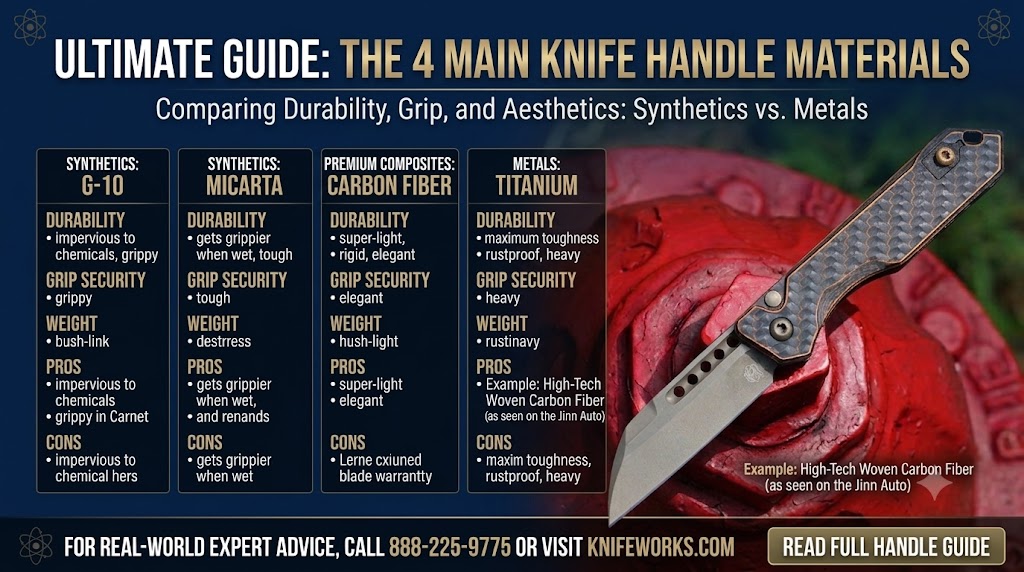
Comparing G-10, Micarta, Titanium & Carbon Fiber
Posted by Knifeworks on 17th Jul 2026
When picking out a new daily carry, we tend to obsess over the blade steel. We check the rockwell hardness, compare edge retention charts, and debate the latest powder metallurgy. But in the hand, the handle material dictates how that knife actually performs. The material wrapping your frame determines your grip security in the rain, how the knife handles a hard drop on concrete, and how much weight you are pulling around in your pocket all day.
Today’s premium market offers everything from aerospace-grade metals to rugged synthetic laminates. The big question is simple: Are tactical workhorses like G-10 and Micarta still the king of real-world utility, or do premium upgrades like Titanium and Carbon Fiber offer functional advantages that justify the higher price tag?
The Hard-Use Synthetic Classics
If you look at the hardest-working knives in the industry, you will almost always find G-10 or Canvas Micarta on the scales. There is a structural reason for this. G-10 is created by layering fiberglass cloth soaked in epoxy resin and curing it under intense pressure. The result is an incredibly dense, rigid material that is completely impervious to water, oils, and chemical exposure. It won't shrink, crack, or chip if dropped onto a hard surface.
Micarta takes a slightly different approach by using layers of linen or canvas cloth. While slightly less rigid than G-10, canvas Micarta possesses a unique performance trait: it actually gets grippier when wet. As your hand sweats or the weather turns, the exposed fabric fibers absorb micro-moisture, texturing the handle against your palm. For an outdoor user or a dedicated work knife, these laminates offer bulletproof dependability at an accessible price point.
Premium Metals & Composites
Stepping up into premium folders brings you face-to-face with Titanium and Carbon Fiber. Titanium (specifically 6Al-4V grade) is highly prized because it delivers the raw structural strength of steel at roughly half the weight. It allows manufacturers to build robust frame locks where the handle scale itself serves as the lock bar. Titanium is completely rustproof, making it excellent for humid environments, though it will collect fine surface scratches—often called "snail trails"—over time.
Carbon Fiber represents the ultimate strength-to-weight ratio in composites. By weaving ultra-fine carbon filaments together in a resin matrix, manufacturers create handles that are featherlight yet extraordinarily rigid along their structural axes. It reduces pocket fatigue to nearly zero. The downside? Smooth carbon fiber can be slick in hand, and it requires precise machining to prevent micro-fractures under massive impact loads.
Handle Material Comparison
Breaking down the core operational metrics helps highlight which material aligns best with your daily work environment:
| Material | Grip Security | Impact Durability | Weight Profile | Maintenance Needed |
|---|---|---|---|---|
| G-10 Laminate | Very High (Textured) | Excellent | Moderate | Zero |
| Canvas Micarta | Extreme (Wet or Dry) | Very High | Light-Moderate | Low (Darkens with oil) |
| 6Al-4V Titanium | Moderate (Slick unless milled) | Maximum | Heavy-Moderate | Low (Shows pocket trails) |
| Carbon Fiber | Low-High (Finish dependent) | Good (Avoid hard crushing) | Ultra-Light | Zero |
Balancing Ergonomics and Aesthetics
Choosing the right material ultimately comes down to your primary use case:
- The Hard Working Utility Carry: If you are constantly working in greasy, wet, or muddy conditions, stick to aggressively textured G-10 or canvas Micarta. They offer a secure, slip-resistant grip that keeps your fingers away from the edge when applying heavy downward force.
- The Precision Everyday Carry: If you want structural rigidity, flat profiles that don't bulk up your pocket, and mechanical longevity, titanium frame locks and lightweight carbon fiber scales offer an engineered refinement that synthetics cannot quite replicate.
There is no single correct choice—only the material that feels right in your hand and fits your daily grind.
Find your perfect handle configuration at Knifeworks — exploring thousands of G-10, Micarta, Titanium, and Carbon Fiber pocket folders. Not sure how a specific handle texturing feels in the palm? Call us directly at 888-225-9775. Our crew handles these folders every single day, and we will tell you exactly how they feel, how they carry, and how they hold up over time.
Frequently Asked Questions
Why is my Micarta handle changing color over time?
Micarta contains exposed organic fabric layers that absorb the natural oils from your skin. This causes the handle to darken and develop a custom patina over time. If you prefer the original lighter factory look, you can easily restore it by scrubbing the scales gently with warm water, soap, and a nylon brush.
Will a Titanium handle scratch easily in my pocket?
Raw or sandblasted titanium will develop light scuffs and superficial rub marks (commonly called "snail trails") when rubbing against keys or coins. These marks are purely cosmetic, do not affect the massive structural strength of the metal, and can be minimized by choosing a stonewashed or textured finish.
Is Carbon Fiber brittle if you drop it?
High-quality carbon fiber is exceptionally rigid and tough against linear pulling forces, making it perfect for folder scales. However, because it is a composite structure, an extreme, direct impact against a sharp edge—like dropping it directly onto stone or crushing it—can cause the resin to crack or delaminate more easily than ductile metals or flexible G-10.