
Toughness vs. Wear: Premium Knife Steels Explained
Posted by Knifeworks on 17th Jul 2026
Just when the knife world settled into CPM MagnaCut as the undisputed king of balanced everyday carry, the goalposts moved again. The latest generation of powder metallurgy has introduced highly specialized formulas designed to push performance boundaries even further. Buyers are no longer just hunting for general premium steel; they are looking for specific performance advantages tailored to how they actually use their blades.
The biggest question on the workbench today: Should you stick with a balanced, tough-as-nails daily user, or make the leap to a dedicated high-wear specialist?
Toughness vs. Wear Resistance
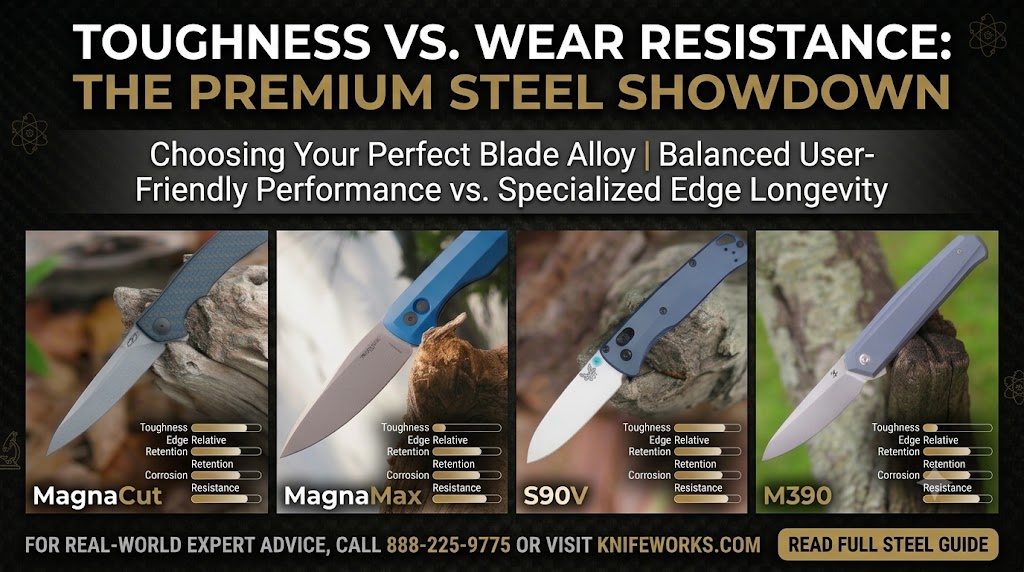
In knife metallurgy, everything is a compromise. You cannot drastically increase edge retention without shifting the chemical microstructure. Balanced steels like CPM MagnaCut are engineered to do everything exceptionally well—offering massive corrosion resistance and high toughness so the edge won't chip under heavy pressure.
On the other side of the coin sit high-wear specialists like CPM-S90V and the new MagnaMax. By cranking up the vanadium and niobium content, these steels form dense networks of incredibly hard carbides. The tradeoff? They lose a bit of impact toughness, but they hold a slicing edge far longer than balanced steels when cutting abrasive materials like cardboard, rope, and heavy packaging.
Premium Steel Comparison
Understanding how these premium alloys compare on the factory floor helps clarify what you are actually putting in your pocket:
| Steel Grade | Edge Retention | Toughness | Corrosion Resistance | Typical Hardness (HRC) |
|---|---|---|---|---|
| CPM MagnaCut | High | Very High | Excellent | 61-63 |
| MagnaMax | Extreme | Moderate-High | Excellent | 63-65 |
| CPM-S90V | Extreme | Low | Good | 59-61 |
| Böhler M390 / 20CV | High | Low | Excellent | 60-62 |
Choosing Your Ideal Edge
Matching a steel to your routine keeps your knife working efficiently on the job:
- The Case for Balance: If your knife regularly encounters dirt, staples, outdoor tasks, or light prying, you want an alloy that bends before it breaks. High impact resistance ensures you won't roll or chip your edge during unexpected micro-impacts.
- The Case for Extreme Longevity: If your daily use consists of endless box cutting, rope slicing, or skinning, impact toughness takes a backseat to pure wear resistance. You want hard vanadium and niobium micro-carbides that keep working long after standard steels require a touch-up.
Sharpening Realities
Keep in mind that high hardness and dense carbide structures require a proper sharpening setup. Balanced steels are relatively forgiving on traditional ceramic stones, while high-wear alloys perform best with premium diamond or CBN abrasives to efficiently shape the ultra-hard carbide structures without causing micro-tears along the edge bevel.
Ultimately, there is no single perfect steel—only the perfect steel for the job at hand.
Explore our comprehensive collection of premium blades at Knifeworks — featuring the latest releases in CPM MagnaCut, MagnaMax, Spyderco premium folders, and elite custom configurations. Call 888-225-9775 if you want a real-world read on how one of these carries before you buy; we handle these daily and can talk you through blade length, clip position, and steel tradeoffs for your specific use case.
Frequently Asked Questions
What is the main difference between balanced steel and wear-resistant steel?
Balanced steel focuses on high structural toughness and impact resistance to prevent chipping under heavy pressure. High-wear steel incorporates hard alloys like vanadium to maximize edge longevity during repetitive, abrasive slicing, trading off a small degree of impact toughness.
Does higher hardness (HRC) mean a better knife?
Not necessarily. Higher Rockwell hardness increases edge retention and resistance to deformation, but it can make the steel more brittle and harder to sharpen on standard field equipment if the edge does chip.
Do I need special stones to sharpen high-wear carbide steels?
Yes, diamond or CBN (Cubic Boron Nitride) abrasives are highly recommended. Advanced high-carbide steels contain vanadium and niobium structures that are harder than traditional aluminum oxide stones, meaning conventional stones will wear down flat before effectively cutting the bevel.