
How 400 Knives Proved the Compression Lock Best
Posted by Anna, Knifeworks on 10th Jul 2026
Every lock mechanism claims to be strong. Almost none of them get tested the way ours did — by accident, on a show floor, against a deadline.
In 2013, we ran a vendor booth as Knife Retailer at a blade show in Atlanta. We brought several hundred knives for sale — folders, fixed blades, a full booth's worth of inventory. On the last day, part of our team had to leave early to get back for the workweek, which left a handful of us to break down and pack everything alone.
That meant closing 300 to 400 folding knives by hand, in a two-to-three-hour window, before the show floor closed and we had to be out.
If you've never had to close hundreds of folders back to back, the differences between lock mechanisms stop being theoretical fast. Liner locks that need a precise thumb angle. Frame locks with tension that fights you by knife number 150. Button locks that are fine one at a time but slow you down at volume. After a couple hundred knives, your hand knows exactly which mechanisms are efficient and which ones are costing you seconds you don't have.
The Compression Lock® stood out immediately. One motion, consistent every single time, no fighting the mechanism to disengage it. It closed faster than anything else in that pile, and it didn't matter if it was knife number 10 or knife number 300 — the action never got harder, never got less predictable.
What Makes the Compression Lock Different
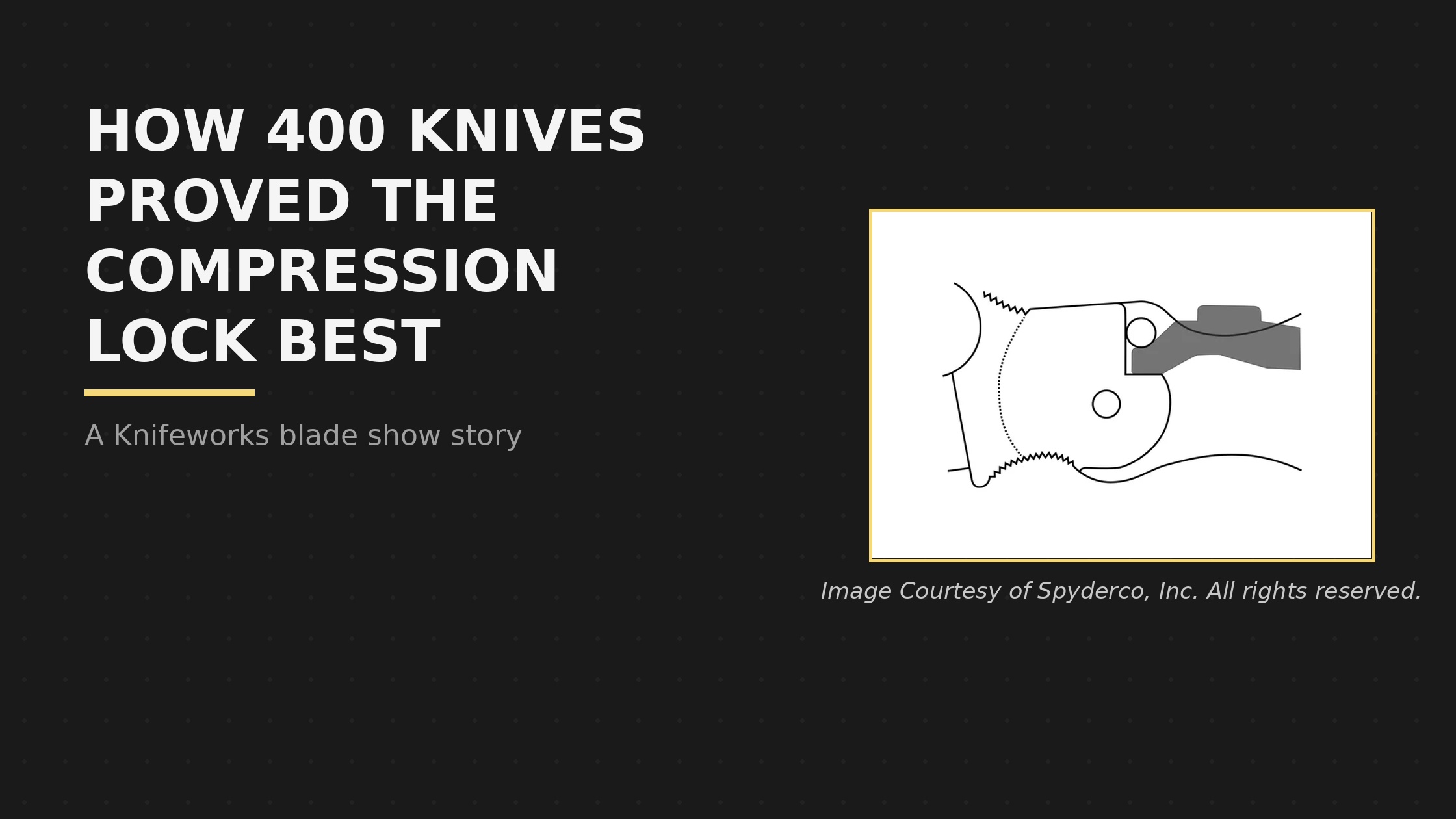
The Compression Lock, invented by Spyderco co-founder Sal Glesser, uses a split liner or nested flat spring inside the handle as the lock bar. When the blade opens, spring tension moves that bar laterally to wedge it between a stop pin and an upward-facing ramp on the blade tang. That geometry is what gives it exceptional mechanical strength — and it's also why the knife closes one-handed without ever placing a finger in the path of the edge, which is exactly the motion that made it stand out closing hundreds of knives back to back.
Why This Matters Beyond a Trade Show Floor
Most people will never close 400 knives in one sitting. But the same qualities that made the Compression Lock the easy standout that day — consistency, low hand fatigue, and a lock that feels secure without feeling stiff — are exactly what matter for daily carry too. A lock you're opening and closing dozens of times a week should feel the same on day 500 as it did on day one.
That's the real test of a lock mechanism: not how it feels the first time, but how it feels the thousandth time.
We've carried and sold Compression Lock knives daily since that show, and it's remained our benchmark for what a folding lock should do. As an authorized Spyderco dealer, we carry the Compression Lock across the current lineup — call 888-225-9775 if you want a recommendation based on blade size, steel, or use case.
Q: What is the Spyderco Compression Lock?
A: The Compression Lock is Spyderco's proprietary locking mechanism, invented by co-founder Sal Glesser. It uses a split liner or nested flat spring inside the handle as a lock bar, which wedges between a stop pin and a ramp on the blade tang when the knife is opened. This design offers exceptional mechanical strength and allows one-handed closing without placing a finger in the path of the edge.
Q: Is the Compression Lock more secure than a Liner Lock or Frame Lock?
A: The Compression Lock is widely regarded as highly resistant to inadvertent disengagement because the lock bar sits on the spine of the handle, away from where fingers grip during use, unlike a Liner Lock or Frame Lock where the bar sits closer to the grip area.
Q: Why do knife retailers and collectors prefer the Compression Lock?
A: Consistency at volume. The lock engages and disengages the same way every time, with low hand fatigue, which becomes noticeable to anyone opening and closing folding knives repeatedly, whether professionally or through daily carry.